Blog · 2026-11-17
Introducing Workcraft — an AI-native low-code platform you can self-host for free
One platform that does the job of three — internal tools, app platform, workflow automation — plus AI that builds the app for you.
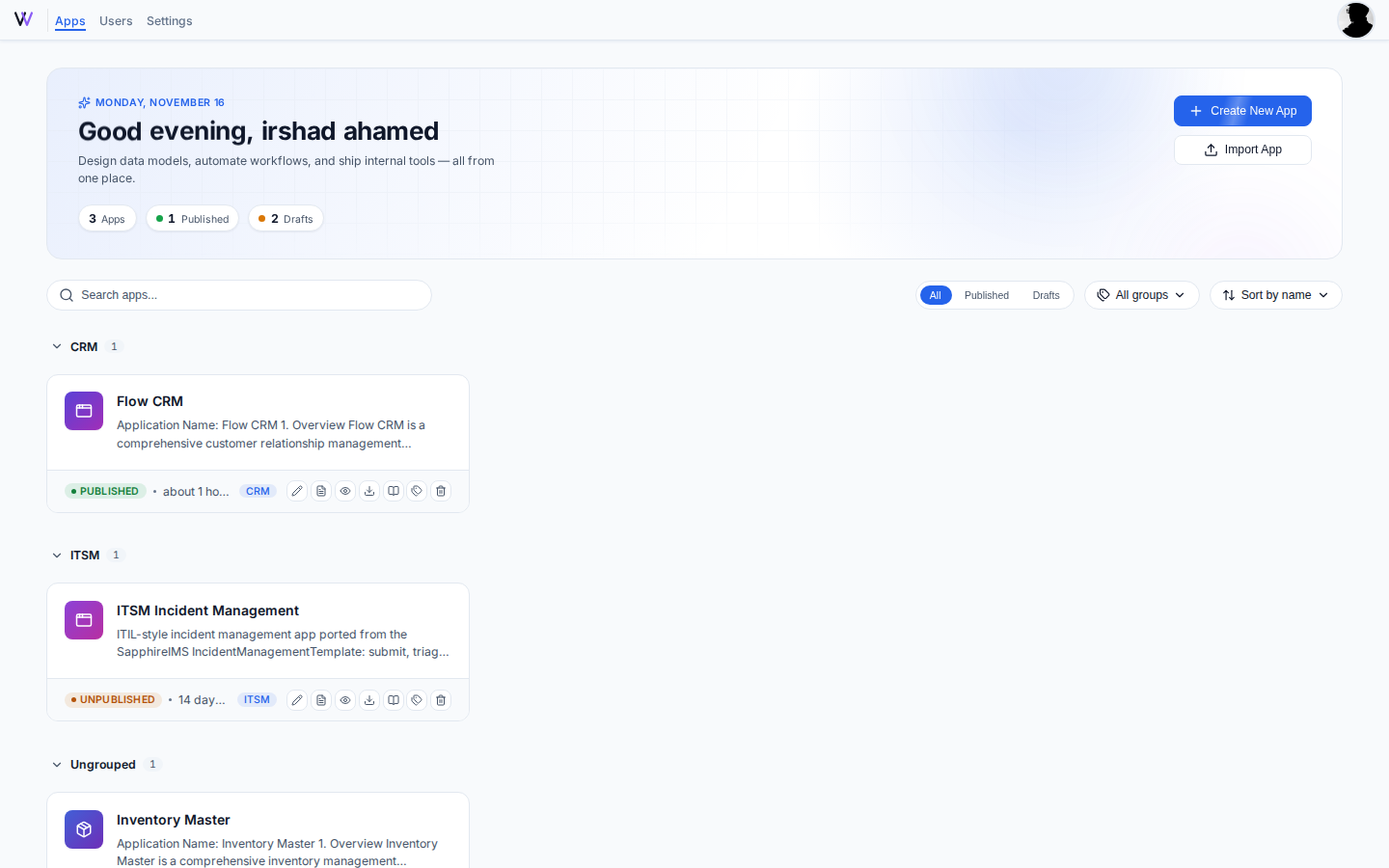
Today we're launching Workcraft — a low-code platform built to cover the three tools most internal-software teams end up paying for separately:
- Internal-tool builder (Retool/Appsmith class) — drag-and-drop pages, forms, lists, dashboards, kanban, calendars
- App platform (Bubble class) — multi-tenant apps with roles, environments, versioning, theming
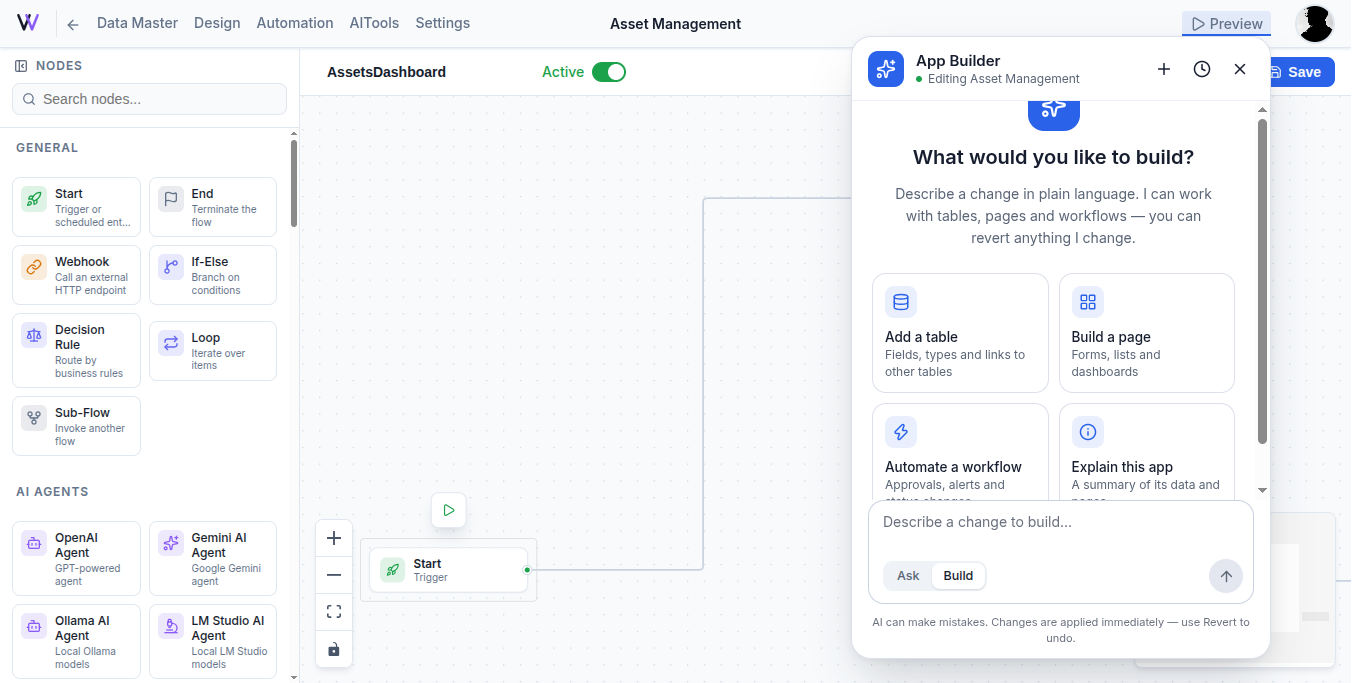
- Workflow automation (n8n class) — a visual flow designer with 43+ node types: AI/LLM nodes (OpenAI, Gemini, Ollama, LM Studio…), triggers, logic, data transforms, integrations, approvals, notifications
Plus one thing the three-tool stack can't do: describe an app in plain English and watch AI generate the data model, pages, roles, and menu — a staged pipeline (Requirements → Planning → Data Sources → Pages → Roles → Menu → Validation) you can inspect at every step.
Self-host it for free — really
No Kubernetes requirement, no Helm chart, no "self-hosting is an Enterprise feature" gate. Retool moved self-hosting behind its Enterprise plan — Workcraft's free tier self-hosts on plain Docker, including a production-hardened single-image build with embedded MongoDB.
Self-hosting is a first-class deployment option, not an enterprise upsell. It's available on request — get in touch through the demo form and we'll set you up with the self-host package.
Fair warning on the license, since you'll check anyway: it's source-available under a commercial license, not OSI open source — access is available on request. You can self-host the free tier; you can't resell it.
No per-seat pricing, no per-task metering
Two pricing complaints keep coming up in this space, so here's where Workcraft lands on both:
- Per-seat pricing — the thing that makes internal tools die at rollout. Workcraft plans are flat limits (users / apps / workflows / AI generations per month), not per-user line items. A 5-person team and a 25-person team aren't a pricing conversation.
- Per-task / per-credit metering — automation platforms that bill per task, per credit, or per "operation" turn every new workflow into a finance review. Workcraft plans don't meter executions; the only metered allowance is the monthly AI-generation count, which is a flat included number, not a tax on usage.
Current enforced tiers (what the app actually checks server-side):
| Users | Apps | AI generations/mo | |
|---|---|---|---|
| Free | 5 | 2 | 25 |
| Starter | 25 | 10 | 250 |
| Pro | 100 | 50 | 2,000 |
| Enterprise | unlimited | unlimited | unlimited |
Paid tiers are contact-sales for now — there's no self-serve checkout yet, and we won't pretend there is.
What's under the hood
For the dev crowd, the short stack list:
- Backend: Spring Boot (Java), embedded-or-external MongoDB, JWT auth, Stripe/Twilio/Slack/Teams/DocuSign channel plumbing
- Frontend: Vue 3 + Vue Flow for the designers
- Datasources per app: MongoDB, MySQL, PostgreSQL, SQL Server, REST, Google Sheets, Airtable
- AI: Spring AI with OpenAI; multi-provider LLM nodes in flows
- Ops: Git-style app versioning (branch/diff/rollback), environments, audit logs, SSO/SAML + SCIM on Enterprise
Full setup and feature docs live at workcraft.app/docs.
Where this is going
The hosted demo is being rebuilt right now, so the honest call to action today is: request self-host access, run the free tier on your own Docker, and tell us what's broken or missing. There are short demo videos on our YouTube channel if you want the two-minute version first — and feedback goes through the demo form.
Want to try it? Get a demo workspace or read the docs.